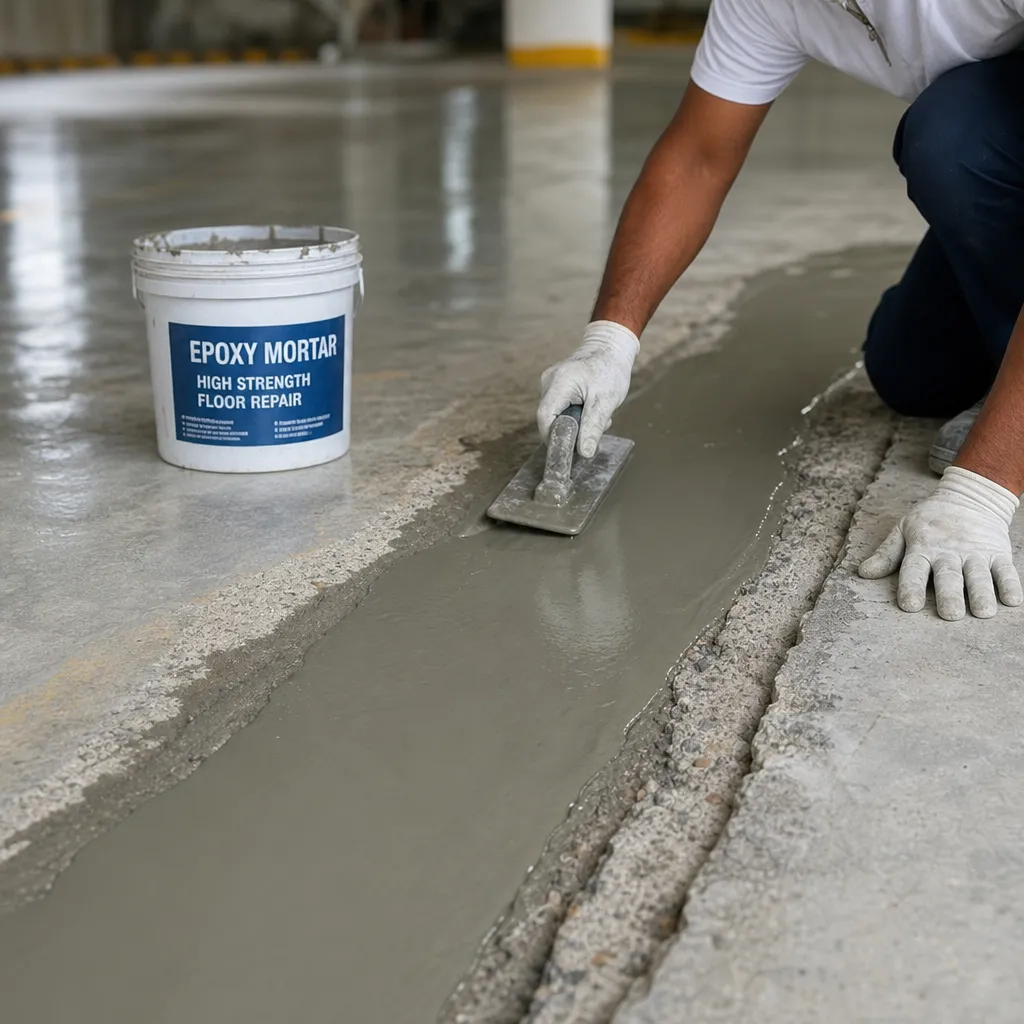
RCC floors take a lot of punishment—water seepage, chemical spills, heavy foot traffic, vibrations from machinery, and repeated temperature changes. Over time, this can lead to cracks, scaling, hollow sound patches, spalling, or loss of surface strength. One of the most common and effective approaches for targeted RCC floor repair is epoxy mortar.
This guide explains what epoxy mortar is, why it’s used for RCC floor repair, the correct preparation steps, thickness/curing considerations, durability expectations, and common mistakes—so you can plan repairs with clarity and confidence.
---
What Is RCC Floor Repair with Epoxy Mortar?
Epoxy mortar is a repair material made by mixing an epoxy resin with a selected aggregate (sand/graded mineral filler) and sometimes additives for workability and bonding. In RCC floor repairs, epoxy mortar is typically used to:
- Rebuild damaged concrete surfaces
- Restore load-carrying capacity (at the repaired zone)
- Create strong adhesion to sound concrete
- Reduce water ingress at the repair boundary
Think of it as a “bonded patch” system—where the quality of surface preparation and mixing usually matters as much as the material itself.
---
Why Epoxy Mortar Works Well for RCC Floor Repairs
1) Strong bonding to concrete (when done correctly)
Epoxy forms a chemical and mechanical bond with properly prepared concrete. If the surface is contaminated, weak, or not roughened, the bond can fail early.
2) Low permeability and water resistance
Epoxy mortar repairs can significantly reduce water migration—especially important where cracks or patchy deterioration allow seepage.
3) Good compressive and abrasion resistance
For floors subjected to wear (warehouses, commercial spaces, service areas), epoxy mortar patches can offer improved resistance compared to many conventional cementitious repairs.
4) Fast return to use (depending on system and curing)
Many epoxy systems are designed for controlled curing schedules—helping reduce downtime, which is often critical in operational buildings.
---
Common RCC Floor Defects Where Epoxy Mortar Is Used
Epoxy mortar is most appropriate when the damage is localized and the surrounding concrete is still structurally sound.
Typical issues include:
- Hairline cracks with localized surface damage
- Spalled areas (from impact, corrosion by moisture, or chemical action)
- Surface delamination and hollow-sounding patches
- Depressions and unevenness due to prior damage or poor finishing
- Areas needing a durable “cap” after leak-related repairs
Less ideal cases:
- Widespread structural failure (the slab may need structural intervention)
- Very deep honeycombing with extensive loss of concrete beyond localized repair
- Repairs where rebar corrosion is advanced and not addressed
- Active movement/cracks that continue to widen (epoxy alone may not accommodate movement)
---
The Key Principle: Epoxy Repairs Are Only as Good as the Preparation
Before applying epoxy mortar, the job is essentially won or lost during preparation.
Step 1: Inspection and soundness check
A proper repair starts with identifying:
- Crack type (static vs active)
- Extent of delamination
- Whether the concrete is sound or fractured internally
- Presence of moisture (especially surface moisture)
In many sites, teams check with visual assessment, tapping/hollow detection, and sometimes moisture evaluation.
Step 2: Concrete removal to reach sound substrate
Damaged concrete is removed until you reach:
- Clean, solid concrete
- No loose particles
- No standing water
- No laitance or weak surface layer
For epoxy mortar repairs, “patching over” weak concrete is a common failure cause.
Step 3: Mechanical roughening
Epoxy systems rely on surface profile. Typical approaches include:
- Grinding / scarifying
- Controlled surface roughening
- Vacuum cleaning after grinding
Step 4: Cleaning and drying
This step is critical in RCC floors. The repair zone must be free from:
- Dust and debris
- Oil/grease
- Paint residues
- Moisture contamination
Even “small” contamination can break adhesion.
---
Epoxy Mortar Application Process (What Usually Happens on Site)
While exact steps vary by product system, a reliable workflow looks like this:
1) Primer or bonding coat (if required by the system)
Many epoxy repair systems use a primer to improve bonding and seal the surface. It’s applied to the prepared concrete area as specified.
2) Mixing epoxy and aggregate correctly
Epoxy mortar performance depends on achieving the correct:
- Resin-to-hardener ratio
- Aggregate grading
- Mixing time and uniformity
If mixed incorrectly, you can get:
- Weak bonding
- Poor curing
- Reduced strength and durability
3) Placement and compaction
The mortar is applied to the required profile and thickness. For good results:
- Ensure full contact with the substrate
- Avoid entrapped air pockets
- Shape the repair to match floor levels and slope requirements
4) Leveling and finishing
Depending on floor use, finishing may be:
- Trowel finished
- Broadcast with aggregate
- Prepared for coating or topwear layer later
5) Curing and protection
Epoxy systems require a controlled curing window. Repairs should be protected from:
- Foot traffic and point loads too early
- Water exposure before full cure
- Dust contamination during cure
- Excess heat/cold outside specified ranges
---
How Thick Should an Epoxy Mortar Repair Be?
Thickness depends on:
- The repair depth and area
- The epoxy system’s max application thickness per layer
- Whether it’s a bonding patch or a structural build-up
- Substrate conditions
In general practice:
- Small localized repairs may be done in a single placement if within limits
- Deeper repairs are often layered (to control shrinkage/curing and ensure performance)
Because over-thick application can lead to curing issues and reduced strength, it’s important to follow the manufacturer’s system guidance.
---
Benefits You Can Expect (When the Repair Is Done Right)
A well-executed RCC floor epoxy mortar repair can provide:
- Improved bond strength between old concrete and new repair material
- Reduced water ingress into the repair zone
- Restored surface integrity and reduced loose edges
- Better abrasion resistance for wear-prone floors
- More stable floor surface in localized damaged pockets
If your floor has ongoing seepage issues, the epoxy mortar typically performs best when paired with a proper water management and crack treatment strategy—not just cosmetic patching.
---
Limitations and Risks (So You Don’t Get Unpleasant Surprises)
1) Moisture sensitivity
Epoxy performance can reduce if:
- The substrate has persistent dampness
- There is active leak flow
- Moisture vapor pressure pushes against the coating layer
Where water is involved, the repair approach must be planned around the moisture behavior.
2) Continuing movement cracks
If cracks are active due to settlement or slab movement, epoxy mortar may crack again. In these cases, the repair strategy might need additional measures to handle movement.
3) Poor surface preparation
This is the biggest cause of premature failure:
- dust left on the surface
- weak concrete not removed
- smooth/low-profile surface
- grease, paint, or curing compound residue
4) Incorrect mixing or curing
Incorrect ratios or insufficient mixing can lead to:
- incomplete cure
- softness
- reduced adhesion
---
Epoxy Mortar vs Other Repair Options (Quick Decision Guide)
Epoxy mortar is a strong choice when you need durable bonding and abrasion resistance. But depending on the defect, other materials may be more suitable.
- Cementitious repair mortars: often easier to apply and cost-effective, but may be more permeable.
- Polymer-modified cementitious systems: can bridge performance gaps, but epoxy typically offers stronger bonding and lower permeability.
- Full waterproofing systems: best when water pressure or widespread leak issues exist.
A practical approach is to match the repair material to:
- damage type
- moisture condition
- expected loads
- required finish/finish coating
---
Real-World Use Cases (Especially Common in Industrial/Commercial Floors)
In many Vadodara projects, epoxy mortar repairs are commonly used for:
- Warehouse floor patches around damaged zones or prior leak repairs
- Service area floors where chemical spills and frequent cleaning cause surface wear
- Commercial utility corridors with repeated impact damage
- RCC slab zones where local spalling occurs near embedded services or expansion-related movement areas
On operational sites, teams often plan scheduling to minimize downtime and manage curing safely.
---
Practical Maintenance Tips After Epoxy Mortar Repair
To extend the life of an epoxy mortar patch:
- Avoid heavy point loads immediately after repair
- Prevent chemical spills from sitting on the surface (as per exposure type)
- Maintain proper cleaning methods (no abrasive damage beyond designed wear)
- Inspect repaired zones periodically for edge lifting or new cracking
If you notice re-cracking near repaired areas, it often signals an underlying moisture/structural movement issue that needs a broader look.
---
When to Get Expert Assessment Before Starting
Consider professional inspection if:
- Cracks are widening or repeatedly returning
- There’s continuous dampness or active leakage
- The slab has deep delamination or corrosion signs
- The floor carries heavy machinery with vibration loads
- Previous repairs failed prematurely
In many cases, teams that work on waterproofing and structural strengthening also review the “cause,” not just the symptom—so the repair lasts longer.
---
Conclusion: Epoxy Mortar Can Be a High-Performance RCC Floor Repair—With the Right Plan
RCC floor repair with epoxy mortar can restore strength, rebuild damaged sections, and improve water resistance—but only if you follow the correct process. The most important factors are:
- reaching sound concrete substrate
- ensuring a clean, dry, properly profiled surface
- mixing and applying the epoxy system according to its specifications
- curing and protecting the repair until fully stable
If your site in Vadodara is dealing with floor deterioration alongside water seepage, it’s worth thinking of the repair as part of a broader waterproofing and building protection strategy. For example, contractors working with advanced waterproofing and structural strengthening solutions—like those referenced by local teams such as Drop Lock System—often approach repairs with both durability and cause-control in mind.
---
If you want, tell me:
1) the floor type (warehouse/commercial/residential),
2) the defect (crack/spalling/delamination/ponding), and
3) approximate repair area and depth,
and I’ll suggest a practical repair approach checklist and questions to ask before starting.
Keywords